Three Detailing Channels, and What Volume Actually Buys
Car detailing is a business first and a YouTube niche second. Almost everyone making videos in it has a shop, a product line, or a course behind the channel. Views are not vanity there — they are leads.
That makes it a good place to ask a question that's hard to answer in a hobby niche: what does publishing a lot actually buy you?
I looked at three US detailing channels, all under 11,000 subscribers, all posting this month. One teaches the business. One runs a shop. One sells the products. Their numbers say three completely different things.
One note on method, because it decides the whole answer. "Median" here means the median of a channel's videos in the same length bucket — Shorts at 60 seconds or under, long-form over three minutes — excluding anything published in the last 30 days. Shorts and long-form are different animals with different audiences, and blending them into one number describes neither. A video posted last week hasn't finished collecting its views.
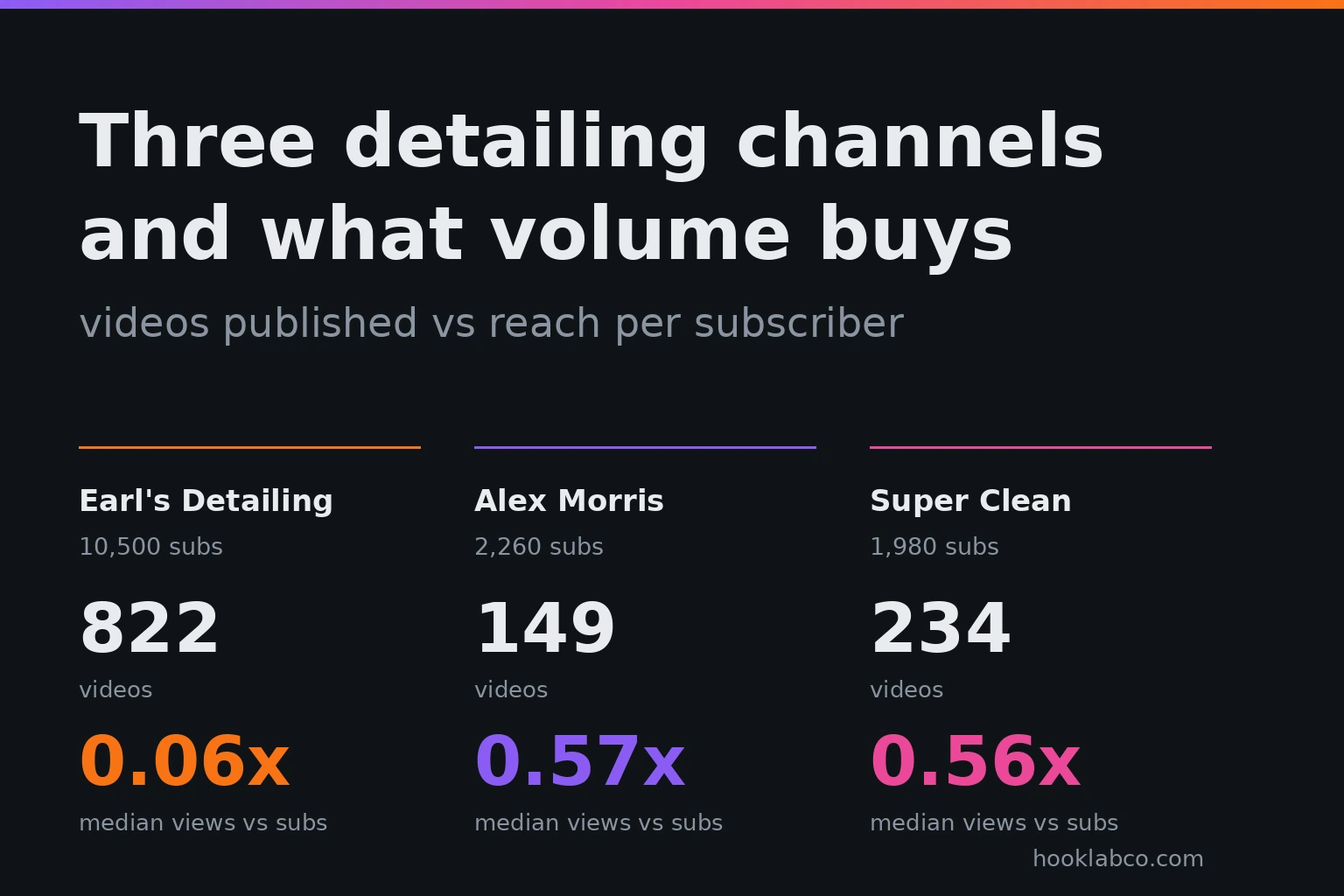
Earl's Detailing — 10,500 subscribers, 822 videos
Earl Miller runs a detailing shop in Atlanta. He has by far the largest audience of the three and by far the most videos: 822, and another one three days ago.
The number: his median Short gets 593 views and his median long-form video 809, against 10,500 subscribers. That's about six people watching for every hundred who follow him.
That gap has a specific explanation, and it's visible in one line of his catalogue. His most-watched video — a Short of soapy floor mats, from January 2023 — has 2,703,265 views. His second-most-watched has 55,234. A factor of fifty between first place and second.
So the subscribers are real, and they came from one video. The 821 that followed haven't repeated it, which is not a failure — it's what virality actually is. Nobody repeats 2.7 million on demand. What the numbers do say is that publishing more did not compound: a bigger catalogue built a bigger back catalogue, not a bigger audience.
For a shop in Atlanta, 10,500 subscribers is better marketing than almost any detailer in the country has. It just wasn't the 822 videos that bought it.
What his numbers suggest testing: his Shorts median and his long-form median are close — 593 and 809. Length isn't buying him a deeper audience, it's just buying him length. His recent long-form runs 30 minutes and over, some of it live. The open question is whether that format is competing for a different kind of attention than the one that built this channel, and the cheap way to find out is a handful of tighter long-form videos measured against that 809.
Alex Morris — 2,260 subscribers, 149 videos
Alex teaches the business side: scaling to $30k a month, turning down cheap jobs, building a booking system for high-ticket work. Five days since his last upload.
The number: his median Short gets 1,488 views. His median long-form video gets 365.
That inversion is the interesting part, because it runs against the channel's purpose. Short-form is where he gets attention. Long-form is where the actual business advice lives — and it reaches a quarter as many people.
There's a second thing worth knowing about his top numbers before reading them as nine separate wins: nine of his ten most-watched videos carry the same title, all published within about three weeks in July 2025. That's a batch, not a streak. Batching near-identical Shorts is a real and legitimate tactic, and it clearly worked — but it lifts a channel's top ten without lifting its median, and those are two different things.
Against 2,260 subscribers, a Shorts median of 1,488 is a healthy number. The question his catalogue raises isn't whether the channel works. It's whether the part that sells is the part being watched.
What his numbers suggest testing: the business advice is in the 365, and the attention is in the 1,488. Those are the same audience arriving through two doors and only walking through one. The testable move isn't to abandon long-form — it's to find out whether the specific arguments that sell (turning down cheap jobs, the booking system) travel in the format people actually watch, and then whether the ones who watch the Short come back for the long version.
Super Clean Auto Detailing Supply — 1,980 subscribers, 234 videos
A detailing supply store in Teaneck, New Jersey. They publish more than either of the others relative to their size: 59 videos in the last 30 days, about a quarter of their entire catalogue. They posted five today.
The number: median Short 1,152 views against 1,980 subscribers. But the number that matters here isn't the median — it's the shape around it.
Across 158 Shorts, not one reaches five times their median. Their distribution is unusually tight: 767 at the 25th percentile, 1,152 in the middle, 1,459 at the 75th, and a maximum of 5,439. No spikes at all. Where the other two channels have a viral hit doing the heavy lifting, this one has a floor.
And there's a signal in their long-form that took some digging to see. Excluding the last 30 days, their long-form median *drops*, from 903 to 781. In the other two channels, excluding recent uploads raises the median, because new videos are still accumulating. When it falls instead, it means one thing: what they're publishing now is outperforming their own history.
Their nine most-watched videos are all long-form, all from the last three months, running between 5,700 and 13,500 views against a bucket median of 903. Titles like *I Sell Detailing Products — Here's What I Refuse to Stock* and one on the biggest lies in the industry. They found a format about two months ago and it is working.
What their numbers suggest testing: they're the only one of the three with something clearly working right now, and the risk is not noticing in time. Their Shorts are a reliable floor with no ceiling — 158 of them and not one above five times the median. Their long-form is where the growth is. The question worth answering with their own data is how much of the 43-Shorts-a-month cadence is still earning its place, and what happens if some of that effort moves to the format that's climbing.
What the three of them show together
Line them up and the ranking inverts twice.
By subscribers: Earl's, Alex, Super Clean. By views per subscriber: Alex and Super Clean are effectively tied around 0.57, and Earl's is at 0.06 — ten times lower with five times the audience. By trajectory, the order flips again: the only channel getting measurably better is the smallest one, and it's the one that has never had a hit.
None of that is visible from a subscriber count. It isn't visible from a video count either, which is the more surprising half: 822 videos and 149 videos produced roughly the same audience size, and neither number predicted which channel would be improving.
What did predict it was boring. A tight distribution with no viral spike means a format that reliably reaches people. A single enormous outlier and a low median means one lucky video and a lot of publishing since. Those two shapes look identical if you only ever look at totals.
If you run a detailing business with a channel attached, all three of these are worth your time — Earl's for the craft, Alex for the business, Super Clean for the product calls. They're small enough that it matters.